Texas Surveillance Bill of Rights
Since we have no elected official stepping forward to write a "Texas Surveillance Bill Of Rights," I took the liberty of doing so myself because I believe that the liberties guaranteed by the United States Constitution and the Texas Constitution are enduring principles that do not diminish as technology advances.
Public safety and constitutional liberty are mutually reinforcing objectives. Technology should enhance the ability of law enforcement to protect the public while preserving the freedoms that define a free society. The purpose of this "Texas Surveillance Bill of Rights" is not to prohibit technological innovation, but to ensure that innovation remains accountable to the Constitution and to the people of Texas.
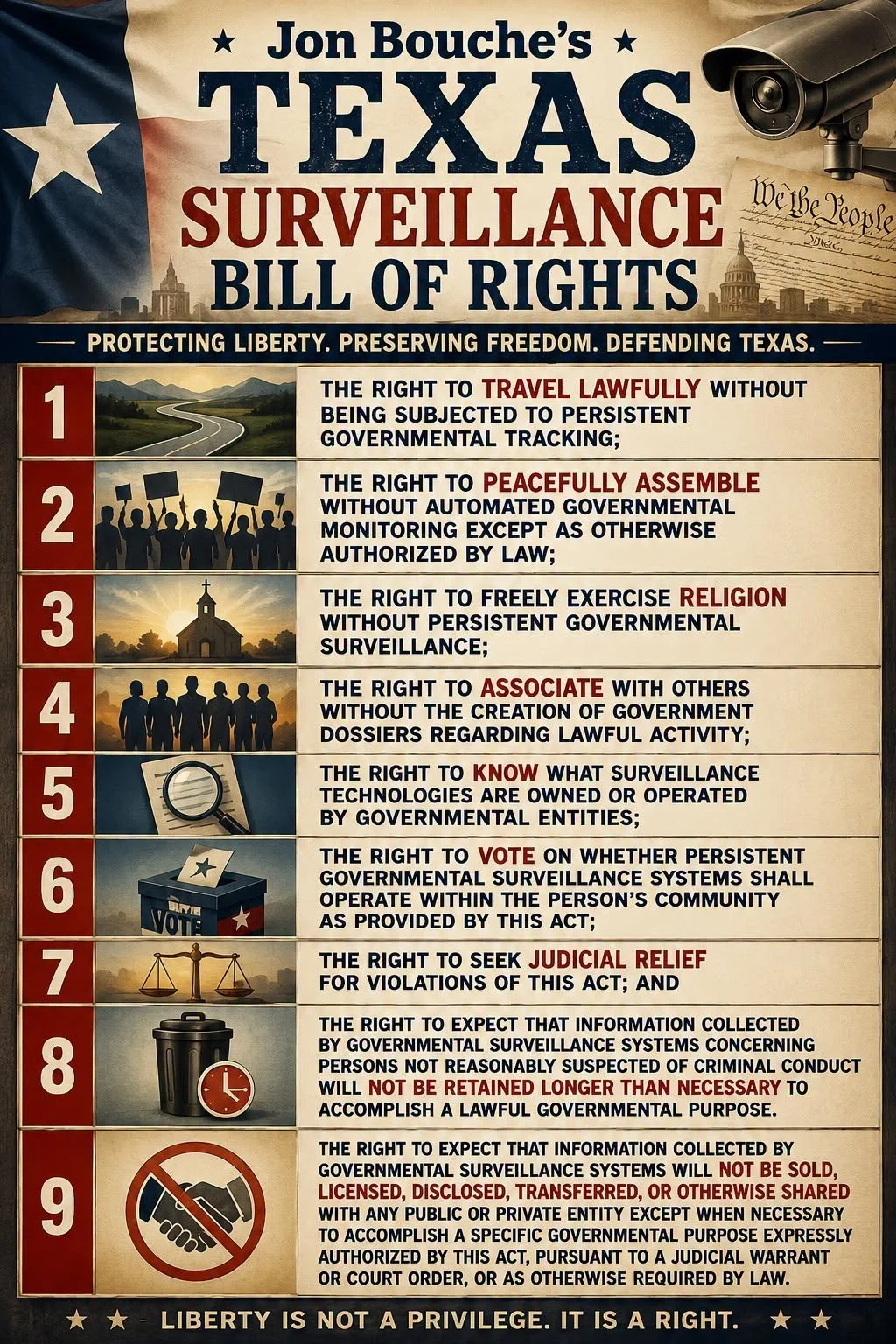
Jon Bouche's Texas Surveillance Bill of Rights
1. The right to travel lawfully without being subjected to persistent governmental tracking;
2. The right to peacefully assemble without automated governmental monitoring except as otherwise authorized by law;
3. The right to freely exercise religion without persistent governmental surveillance;
4. The right to associate with others without the creation of government dossiers regarding lawful activity;
5. The right to know what surveillance technologies are owned or operated by governmental entities;
6. The right to vote on whether persistent governmental surveillance systems shall operate within the person's community as provided by this Act;
7. The right to seek judicial relief for violations of this Act; and
8. The right to expect that information collected by governmental surveillance systems concerning persons not reasonably suspected of criminal conduct will not be retained longer than necessary to accomplish a lawful governmental purpose.
9. The right to expect that information collected by governmental surveillance systems will not be sold, licensed, disclosed, transferred, or otherwise shared with any public or private entity except when necessary to accomplish a specific governmental purpose expressly authorized by this Act, pursuant to a judicial warrant or court order, or as otherwise required by law.
Technology should make constitutional policing more effective, not make constitutional limits less meaningful. I have spent quite a bit of time writing a bill for this purpose and I will be sending it to certain legislators whom I think will carry it.